- WizWorld Scriptorium
- Posts
- Censorious Thesaurus

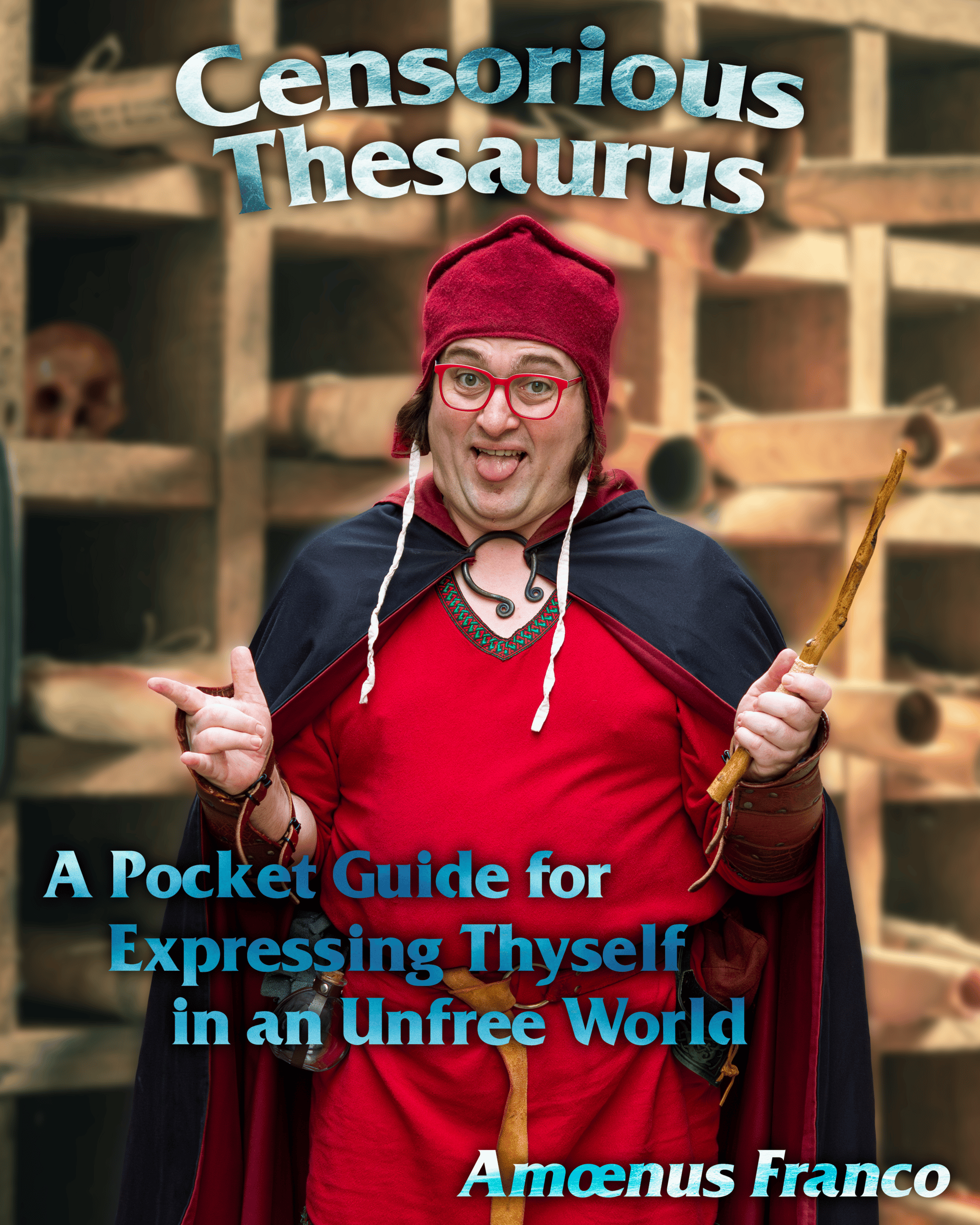
Greetings on this dour Monday, mortals. Another murderous weekend in the Imperium Americum, dousing all in misery, testing all good souls. I notice that many mortals find themselves increasingly chafing against the various layers of censorship sitting atop them, in a land dedicated to “free speech.” Many wish various forms of vengeance or suffering, to be visited upon the murderous pigs, their enablers in Congress, & the oligarchs who fund the whole enterprise.
& so, as a public service, I crafted the CENSORIOUS THESAURUS! When ye wish to express a thought that may result in thy banning from Twitch, or suspension from work, or a visit from the Secret Service—PAUSE! Consult this guide! & enjoy the liberty of unpunishable speech:
THE CENSORIOUS THESAURUS
A Liberatory Manual for Oppressed Speakers
DISCLAIMER: I am a wizard, ne’er admitted to the bar in America nor anyplace else, except for a brief period in Gaul (ca. AD 22-41). I cannot guarantee that this guide shall keep ye free of the donjon, but it shall certainly give thy lawyer something to work with.
Ho there, mortal! So, ye wish to say something dangerous? & ye live in a repressed country, surf repressed web-sites, which ye cannot afford to lose? Let me help! Simply follow these easy rules, & ye shall enjoy a freedom of speech ne’er before experienced on EARTH:
Use florid, indirect language.
Abuse the privilege of fiction.
Express non-positive sentiment.
Do not say “kill” nor “die.”
Simple, no? Allow me an illustration: imagine ye read in the news that a Democratic Senator who claims to “listen to the people,” votes to allot full funding to the bloodthirsty slayers at ICE, despite the fact that more than half of American mortals dislike the Gestapo. This fills ye with rage, & ye begin to inscribe a Tweet—”I WISH YOU WOULD DIE.”
Væ, NAY! All wrong! This is too direct—’tis too non-fictional—it frames the dying as a wish, something desirable—& it says “die.” On most web-sites, this is sufficiently violent to merit a total ban. & it could be construed as a threat, in a legal sense, or an incitement of violence. Instead, let us apply the Four Points, & transform this hasty outrage into something more potent—& less actionable!
First, per Point Four, let us replace “DIE.” Not only are “die” & “kill” generally actionable, they are boring. Uncreative! We shall utilize Point One, now. Instead of “die,” why not “fall into Perdition’s Flames & face the Final Judgment?” There is no possible way to construe this as a serious threat, e’en though reaching Perdition’s Flames requires death, as we do not indicate when this should occur. Obviously, the intent is sooner rather than later, but ye may simply declare ye meant it for when they die of old age many years from now of natural causes. ‘Tis florid, & indirect, though its true meaning is clear!
Now, we must adhere to Point Three for extra security; ‘tis simple, we need only remove “I WISH.” Particularly on web-sites, expressing positive sentiment about violence, harm, or e’en negative things, which happen to others, can result in punishment, because the oligarchs are oppressive maniacs with a lust for control. Therefore, statements like “I wish…” or “It would be awesome if…” all can cause trouble. “Interesting,” though, is always perfectly acceptable, for it expresses a sentiment neither good nor ill!
So—removing “I WISH,” if ye simply reply now, “FALL INTO PERDITION’S FLAMES & FACE THE FINAL JUDGMENT!,” we avoid all possible actionable pitfalls—but we can add e’en more safety still, by utilizing Point Two!
The laziest way to achieve Point Two, would be to append “…in [VIDEO GAME TITLE]” to the end. This is boring, uncreative. In addition, some web-sites are becoming intolerant of that loophole, & a court may not consider it a loophole at all. Instead, craft something stronger! Why not, “A GLEAMING WARLOCK APPEARS FROM THE SHADOWS, & CASTS THEE INTO PERDITION’S FLAMES, TO FACE THE FINAL JUDGMENT!” ‘Tis impossible to construe it as a threat, ‘tis clearly imaginary (warlocks cannot gleam), & there is no rule nor law against writing interesting short fiction!
“But,” I hear ye complain, “that sounds nothing like how I talk?” Aye, precisely! But if that be too purple of prose, let us attempt another illustration: imagine thy local mayor signs a deal in secret to cooperate with the rapacious Border Patrol thugs. The deal is revealed, & ye attend a city council meeting in order to express a public comment. Ye step to the poorly-maintained microphone, & scream, “I WILL BE HAPPY AFTER I KILL YOU!”
Væ, NAY! All wrong! Too direct, non-fictional, positive, & “kill”-having. But, let us fix this up in way that still sounds like a hep, modern mortal:
“I am working on a script for a movie, where a corrupt mayor works with evil aliens who get off on abusing children. The mayor looks like [DESCRIBE THE MAYOR’S CLOTHING, BUT SLIGHTLY DIFFERENT], & the mayor’s name is [THE MAYOR’S NAME BUT SLIGHTLY DIFFERENT]. At the end of the movie, after the mayor is overthrown, the mayor falls off of a huge cliff. The whole town sees it, & they cheer, even the mayor’s family. The mayor’s body is left at the bottom of the ravine, where vultures & wild dogs treat it as a buffet.
[LONG PAUSE]
I am also working on a script about Charles Barkley going to Mars. Which one should I finish first?”
Ha-ho, see? Perfect! With that creative comment, ye express that the mayor ought to be destroyed utterly, & his corpse desecrated, & that e’en his family wishes he were at the bottom of a ravine—all without actually saying so! No jury could convict ye!
There is no threat, for ye simply describe the plot of a fictional film featuring aliens & a totally legally different fictional mayor! & ye never say whether ‘tis good that the mayor character perishes, only that the fictional townsfolk & the mayor’s whole fictional family cheer for his doom. & by adding the bit about a second script centered on Barkley in space, ye establish that the mayor concept is but one of many other creative projects!
I could provide so many examples—the mortal world teems with rank villains & abject cruelty—but I leave further creative non-threats, as an exercise for the reader. Go forth, dear mortals, & harangue freely! Unleash thy tongues, scream at the ghouls, secure in the knowledge that ye know how to scream in such a way as to avoid costly litigation!
The Four Points, once more, for reference:
Use florid, indirect language.
Abuse the privilege of fiction.
Express non-positive sentiment.
Do not say “kill” nor “die.”
Thank ye for reading! & we humbly thank that growing clan of mortals who can & do support our works here with coin! GRATIAS!
I shall write ye come Wednesday with news of our next episode—with Summersbane off on necromantic business, I shall find an interesting corner of the Shattered Empire to explore! ’Til then: be safe, be well, & remember, ev’ry cop a bastard…
Cheers,
Amœnus Franco
Wizard, Writer, Linguomancer
Reply